
Imani, Espoir, & Love
Ministries
Branches of Beauty:
The Women of South-Eastern DRCongo
***The women pictured in this article are a few of the women from our congregations doing the work of spreading the gospel, helping their local communities, and otherwise living out the Word of God. Cultural norms in DRCongo dictate how they are pictured in regards to their dress, pose, and who they are with***
BRANCHES OF BEAUTY
The life of the church is like a large tree with several branches, and women represent a very sensitive and significant branch in the flourishing of the church here in our local community and in the churches and their respective communities around the world. The contribution of women is and has been essential to the building and supporting of the Lord’s church and the building and supporting of the community through the church. This has been fundamentally true across all cultures, wherever the good news of Jesus takes root. It is no less true of the beautiful women of the Democratic Republic of Congo that work tirelessly to spread the gospel and live the Word of God each and every day. By taking a look at the ways the women of Patmos Congregation in Dilambwe and Christ the Savior Congregation in Lubumbashi play an essential role in their respective churches and communities, we hope to encourage you in the knowledge that the Lord has an essential place for you as well.


Mrs. Mzrie ILUNGA Mrs. Bethy Mrs. KILOBI KASHO Mrs. Clarisse MWANZA
KABENDWE MUSANJI
Fun Fact:
In DRCongo, the
family name is the most
important and is always
written in all caps. Also,
it typically comes first, so
the correct writing would be:
Mrs. MWANZA Clarisse
Fun Fact:
In DRCongo, formal
pictures are often
taken with a straight
face as a show of respect
for the occasion.
WOMEN OF THE CHURCH:
The women seen in the videos displayed through our Vision Night compilation video are fervent members of our congregations in DRCongo. Like all Christians, they have responded to the call of the evangelical mission of our Lord Jesus, who commanded us: "Go and make disciples of all nations..." (Matt 28:19). Their role is very important, given that they outnumber men across all our congregations. We consider them the strongest branch of the church because of their commitment to the Gospel of Christ. Although they are not authorized to speak before the assembly of men, in accordance with the Holy Scriptures (1 Cor 14:34), we have implemented other strategies to allow them to announce the good news of Jesus. Among other things, evangelization campaigns are organized with them, often including door-to-door outreach. They also take care of the church in the same way they culturally take care of their homes with diligence and pride: sweeping, mopping, wiping windows, washing the church curtains, organizing day-to-day and seasonal events, and shepherding and discipling the youth.
WOMEN IN THE LOCAL COMMUNITY:
The involvement of women in social works has a positive impact within the local community. In this context, they devote themselves to both happy and sad events: illnesses, deaths, births, weddings, or any other occasions. These events are inseparably anchored in the local culture. On every occasion, these women mobilize to provide a small contribution. In the event of a woman giving birth, they assign one or two women to handle household chores at the mother's home. These are seemingly small gestures, but they provide great moral comfort in the eyes of the local community. These women are indefatigable in finding ways to demonstrate the Lord’s love to those around them, letting the ones they come in contact with know that they are seen, known, and loved.


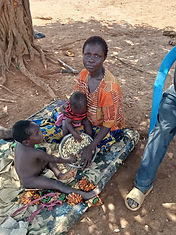
Mrs. MBUYI KYAMILESU Mrs. Daniella KYUNGU Mrs. KIWILO Mrs. Celestine MWANZA Mrs. Pauline ILUNGA
THE UNIQUE CHALLENGES OF WOMEN:
Many of these women play the role of head of the family; by this, I mean they take charge of their household's life. They are divided into two categories: widows and those with living husbands.
· a) Widows: In this category, we often have young women whose husbands have died early; they raise their children alone, managing health, schooling, and clothing—though many times their means do not allow all children to be enrolled in school. This group also includes elderly women who survive thanks to the support of their children, as well as the church's contribution.
· b) Married women: These are women whose husbands have low incomes. They contribute to the family's survival efforts through small activities, such as selling donuts, cakes, or biscuits in front of the school gate; during recess, students come to buy these small items. Others engage in farming activities just to survive with their children.
Women as a whole face many other challenges that they must overcome in order to survive. Access to basic resources, food insecurity, and proximity to war-related fighting are daily companions for many. Access to adult education or skills training is limited or non-existent, putting many women at a steep disadvantage when it comes to working in an established business, starting their own business, or engaging in some type of trade that could ease the scarcity they and their families are accustomed to.
WOMEN AND EDUCATION:
What we should note here is that 70% of the women in our communities are illiterate; they can neither read nor write nor perform basic mathematics. Meanwhile, only 30% of them have even had access to some form of education. The reasons are manifold: lack of schools altogether, early marriages, and teenage pregnancies, to name only a few. In Patmos Congregation in Dilambwe, we have two educated women: one finished secondary school, and the other finished secondary school and went on to study public health. It is a well known fact that second to the Gospel, education is the best way to alleviate poverty and provide upward mobility within a community. Our hope at Imani, Espoir, & Love Ministries is to spread the gospel of Jesus Christ by meeting this need; we strive to work with these women in their communities to remove barriers to education and create opportunities for upward mobility while we share with them the love that their creator has for them and His plan of salvation for their lives.
Wherever the Gospel of Jesus is preached, women are not only uplifted, but also an integral part of demonstrating the precepts of Jesus, thereby making disciples as commanded in Matthew 28:19. No where is this more true than with the women of Patmos Congregation in Dilambwe and Christ the Savior Congregation in Lubumbashi. The Word of God has impacted the lives of these women, bringing them hope and through that, a commitment to sharing that hope with their brothers and sisters in their respective communities. Just as the Lord has invited each of these women to the table, we pray that you know that He has a place for you as well. He's called your name and invited you to share at His table, where you can dwell in hope and the knowledge that all things are being made new.

